Tuesday, March 27, 2007
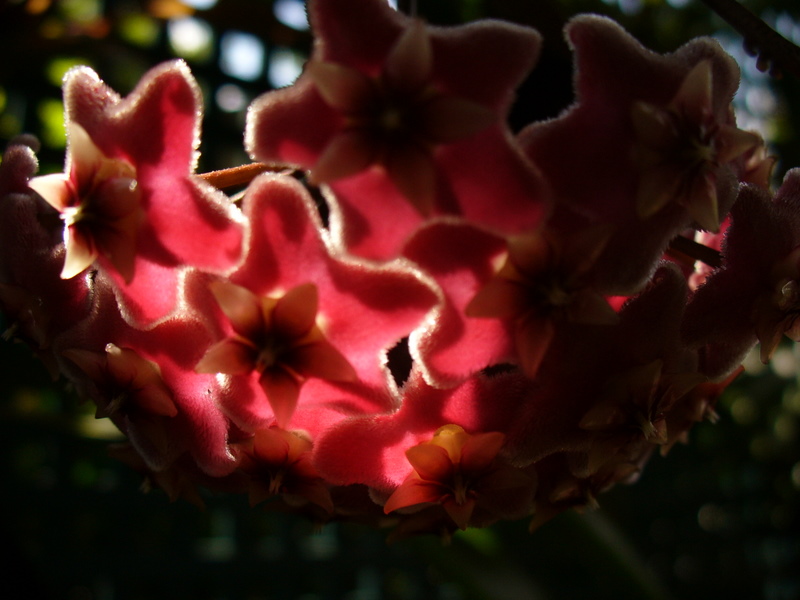
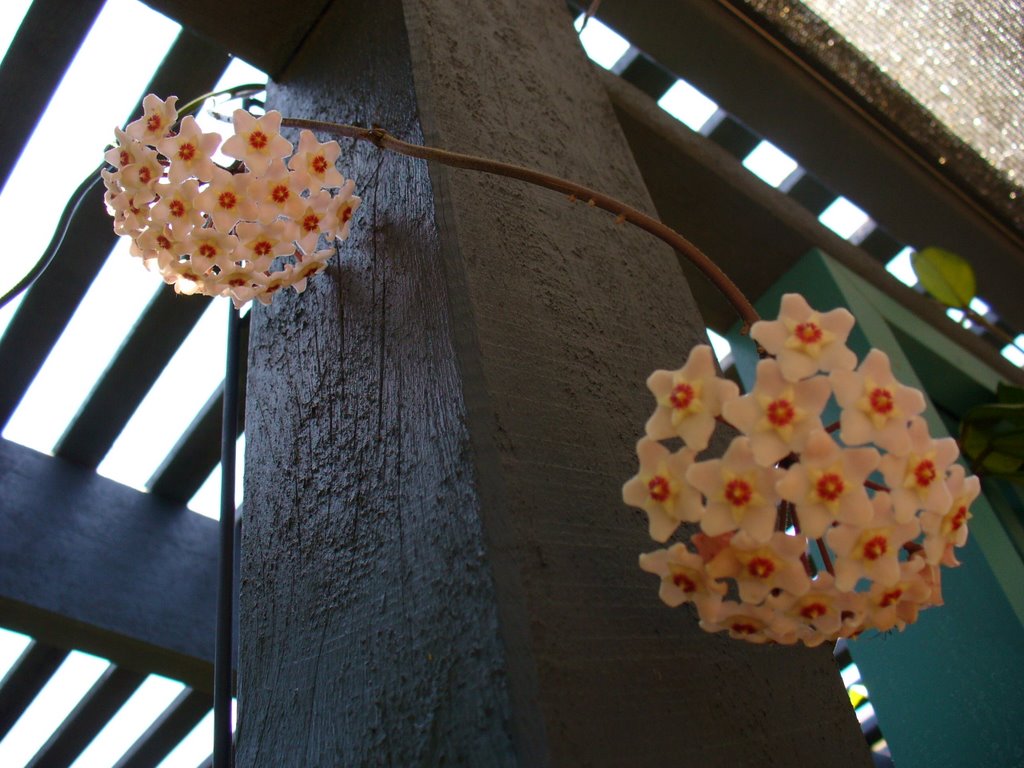
Little epiphyte ball.
Tuesday, March 06, 2007
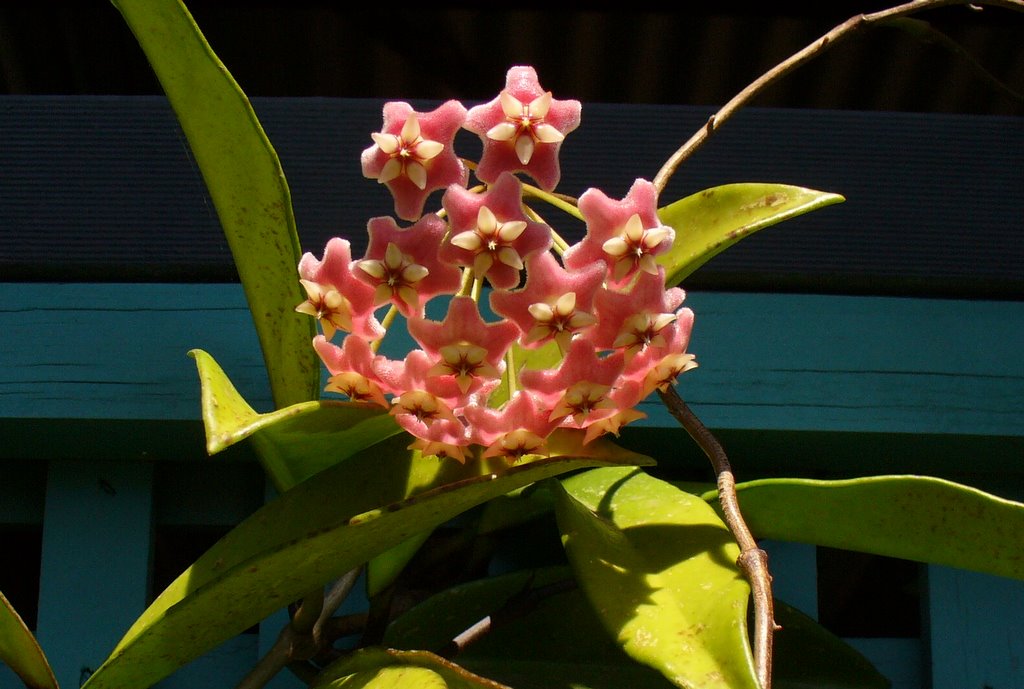
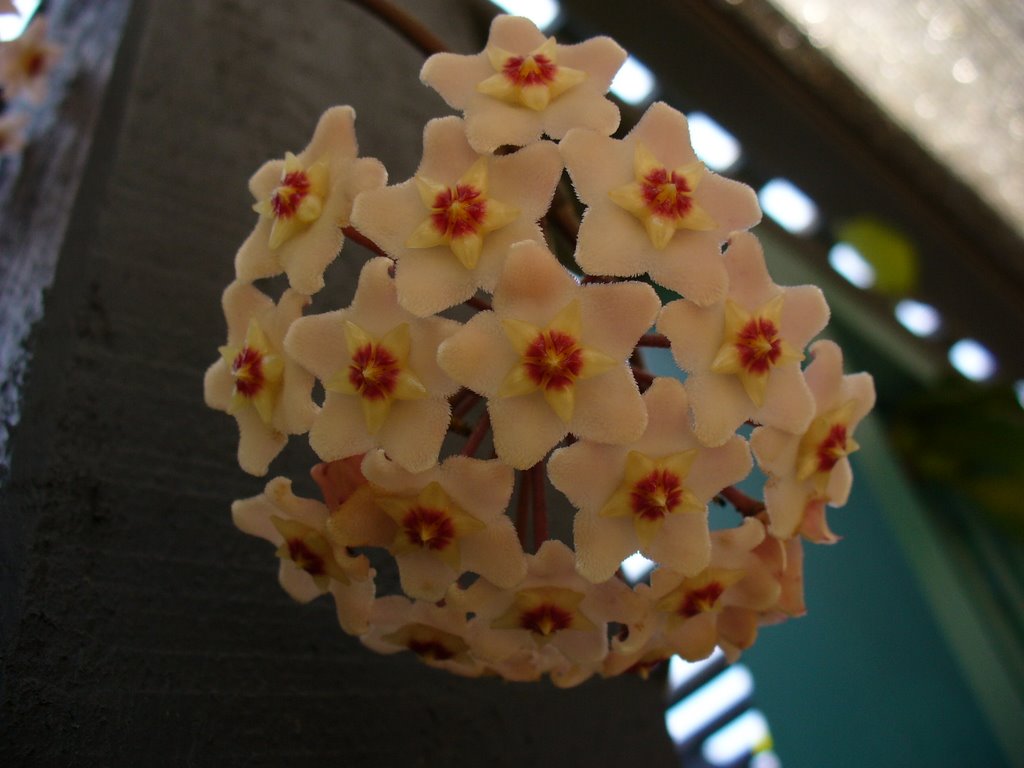
Hoya wayetii bloom.
Another list of Hoyas
37 H. sipitangensis.
38 H. Imperialis.
39 H. meliflua.
40 H. longifolia.
41 H. acuta.
42 H. longipenduculata. ( unpublished name)
43 H. deykei.
44 H. Aff. vitellina.
45 H. kenjeniana.
Friday, January 19, 2007
Sunday, January 14, 2007
H. subquintuplinervis has flowered again.
When I first started growing Hoyas, I can remember reading that one had to be careful not to remove the peduncle because the plant would invariably flower again at the same point. I thought at the time that must mean in the next season. So I've been pleasantly surprised to have three of my Hoyas flower twice on the same peduncle within a month. At the moment H. carnosa is repeat flowering too. It would be great if I could get a seed pod, the two plants are close by so the bees might do a little something.
More Hoyas

28. H. australis ssp. australis.
29. H. australis ssp. tenuipes.
30. H. australis "Brookfield" ( David L. lists this one as the best)
31. H. australis "Bamboo Range" Qld.
32. H. arnottiana.
33. H. picta.
34. H. loherii.
35. H. bhutanica.
36. H. obscura.
For best view click on picture, and then click again for larger still.
Thursday, January 11, 2007
More Hoyas again.
Friday, January 05, 2007
More Hoyas.
I'll try and fit in little bits of Hoya news in between my effort to catalogue all the Hoyas.For anyone who was able to read my post "rescued Hoya" I visited the nursery that had the sick hoya. Sadly it has gone..... I hope the man took my advice and took a cutting, but I think that may have been too late. This was definately one hoya that didn't thrive on neglect.
So on to the list... The first two on the collage are the only other ones that have flowered so far. So hopefully lots more to look forward to.
10. H. hueschkeliana. "Pink"
11. H. tsangii.
12. H. serpens.
13. H. magnifica.
14. H. pauciflora.
15. H. odorata.
16. H. naumanii.
17. H. mindorensis.
18. H. Aff. rubida.
Saturday, December 30, 2006
All my Hoyas
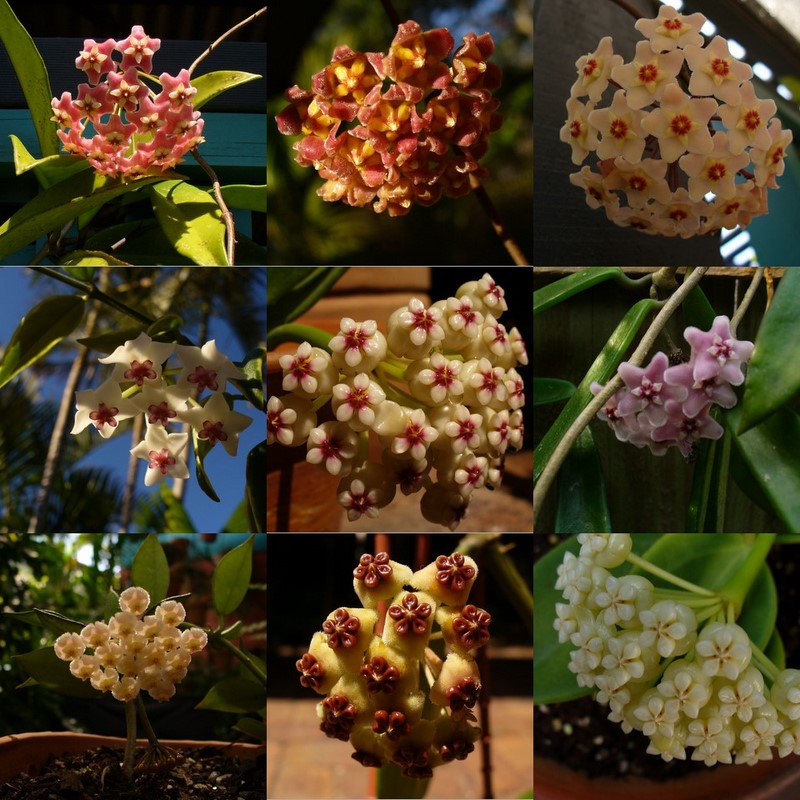
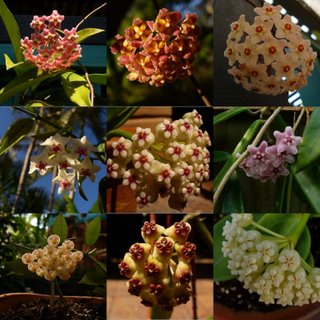
I really couldn't tell you how many different Hoyas I have in my collection. So I thought over the next few weeks I'd try and post a picture of each one and count them in the process. I'll start with the ones that have flowered, not necessarily in order of flowering or in alphabetical order, I'm not that organised unfortunately. So here we go....... from top left to right. Because they will be in collage nine at a time, you may prefer to click on the picture for a larger view and click again for larger still.I hope it's not too boring.
1 H. pubicalyx "pink silver."
2 H. gracilis.
3 H. carnosa.
4 H. bella. ( albomarginate form)
5 H. subquintuplinervis.
6 H. C.V. "Minibelle."
7 H. lacunosa.
8 H. Kerrii.
9 H. Pachyclada.
Sunday, December 24, 2006
Christmas Greetings!
Wednesday, December 13, 2006
Hoya gracilis and Hoya pubicalyx "pink silver"


These are two of the latest Hoyas to flower. I'm sticking my neck out a bit when I say this is "pink silver" because when I planted this Hoya I forgot to put the label in the basket. But looking at other images this appears to be the one. I'm happy to be corrected if anyone begs to differ. The bottom flower is H. gracilis, it is probably not a great specimen as it was on a part of the vine that was starting to wither a little. The rest of the plant is very healthy but no blooms. I've since given it a little prune and I've planted a couple of cuttings from it.
Thursday, December 07, 2006
Hoya curtisii
Monday, December 04, 2006
Hoyas for Africa

This is my little market stall set up as a fundraiser for a project we support in Uganda. It really has been a lot of fun and a most enjoyable time meeting people and talking to people about Hoyas. A number of people bought a Hoya for the first time and the rest were people who were adding to their small collection. I must say I met some really nice people and it would be good if we could get a little informal group meeting occasionally. A cup of tea and enjoy the Hoyas.
Hoya carnosa
Sunday, November 19, 2006
Hoya bella

This is our first Hoya bella flower. The plant is is the albomarginate form which is very attractive. We also have the varigated form which isn't growing anywhere near as vigorously as this one. I can see why Bella's are such popular Hoya's, it will be quite spectacular when it grows into a large pendulous specimen I'm sure.
Hoya Pottsii Sp. 'Chiang Mai'

This Is what I understand to be Hoya Pottsi Sp, 'Chiang Mai' It wasn't purchased from Liddle's nursery, but David tells me that he supplied all this nursery's parent stock years ago. So presuming they have it labeled correctly this is the one. It fits the description of a plant with thick, veined leaves and is said to have cream reflexed flowers.
Friday, November 17, 2006
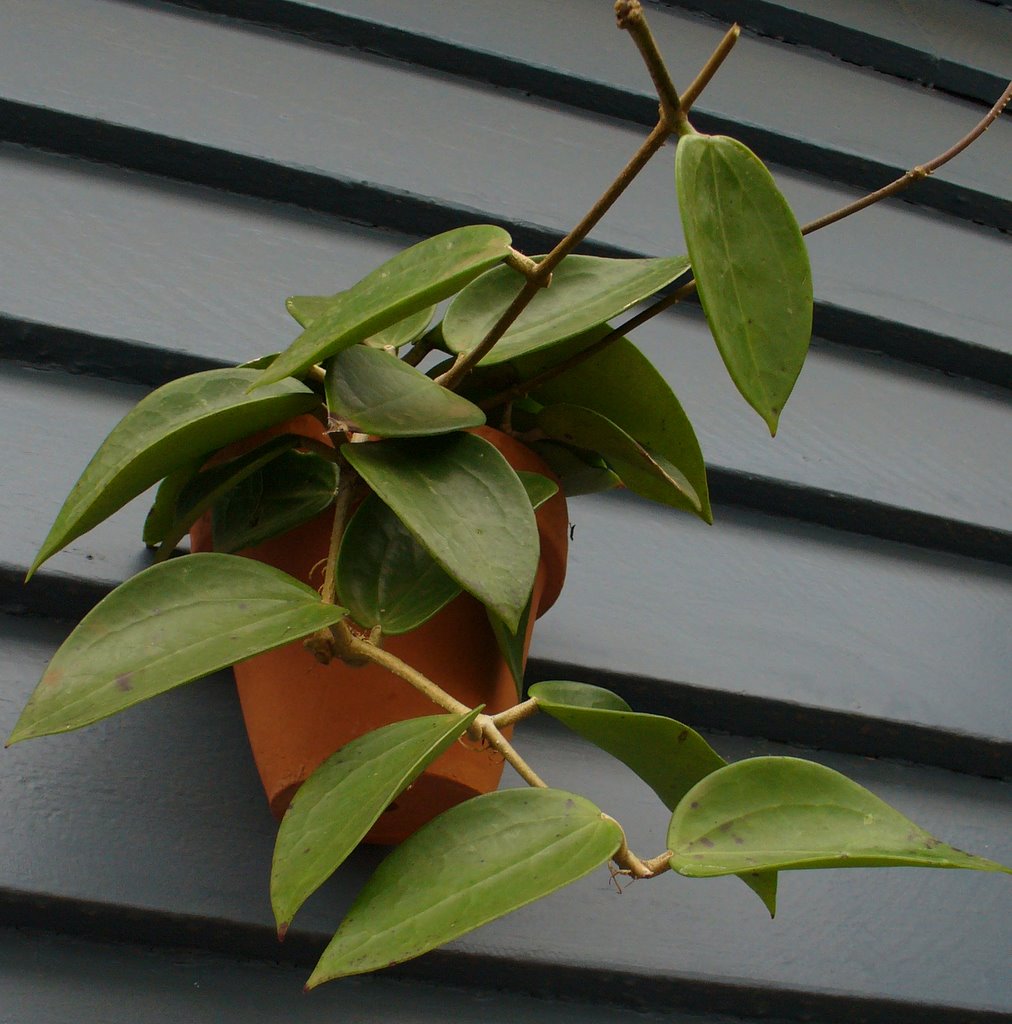
Hoya australis leaves.

I was quite taken with this pair of H. australis leaves with the beautiful veins and the shine on the leaves. The great thing about Hoyas is you can enjoy beautiful verdant green foliage of various shapes and sizes during the growing season. In contrast to the perception of a scruffy neglected plant that some people seem to have of Hoyas they really can be quite striking.
Rescued Hoya.

There seems to be saying about Hoyas in the community that I've heard a few times now. You may have heard this or some variation. "Hoyas thrive on neglect" I've come across this a couple of times in the last fortnight. One was at a visit to a local produce/ nursery supplies where I'd noticed on a previous visit they had a Hoya planted in their garden. It was in pretty poor condition then, and on this occasion the whole plant was limp and yellow. The owner was nearby, so I said I think your hoya may have died. He said " Oh no! it'll be right you don't have to worry about them, It'll be O.K. I said if it's not dead it's close to it. Anyway to cut a long story short, He would have none of it. So I encouraged him to cut the plant back and give it a feed. About a week or so later I felt sorry for the Hoya Australis (pictured above) that was for sale in a local native nursery. It had obviously been in the tube container since being struck as a cutting. The the pot was so swollen I had to cut the plastic, and as you can see the roots of various reeds and grasses had clogged things up somewhat. So I carefully extracated the Hoya from the tangle and gave it a new home in a nice healthy mix of perlite and potting mix. We have to concede that Hoyas are robust, but maybe a better saying would be "Hoyas resilient in adversity" But like any other plant Hoyas thrive with a little bit of T.L.C.
Saturday, November 11, 2006
Hoya subquintuplinervis

This Hoya is one of my favourites. Yes.... I can pronounce it and I can spell it, which is quite an achievement for me. It comes from Thailand and it is more of a bushy plant than a climber, it has a really exquisite fragrance early morning and evening. It's worth a click for the larger view. There doesn't appear to be a lot of photos on the web of this hoya flowering, the only one I could find was one of Christine Burton's, mine seems to have a lot more red in the corona. I hope we get a double dose of flowering like with the Pachyclada.
For our records Hoya subquintuplinervis flowered first in the second week of November 2006
Tuesday, November 07, 2006
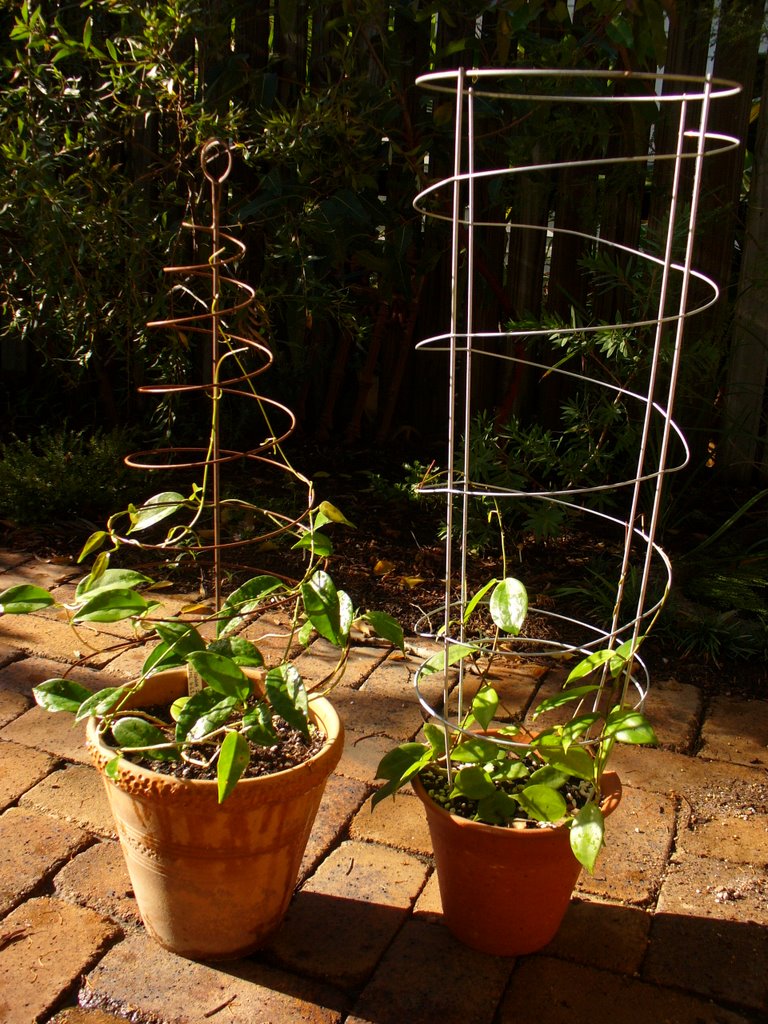
New pot trellises

These are a couple of pot trellises I'm trying out. They are certainly not the easiest things to find. On the left is H. sp. 'Tanna Island, it has small shiny green leaves with pink flowers. I'm hoping it flowers this summer. On the right is H. acuta, I'm told there is so many variations on this Hoya, so I don't really know what colour the flower will be. Both plants seem to be twining nicely up the trellises (with a little assistance) but I wouldn't like to try anything too vigorous I don't think. David Liddle kindly gave me a list of smaller growing Hoyas that he thought would suit this type of trellis. Heres the list for anyone who may find it helpful.
H.bilobata H.burtoniae H.camphorifolia H.davidcummingii H.kentiana H.literalis H.loherii
H.memoria H.myrmecopa H.odetteae H.pusilla H. limoniaca H.tsangii H.nabawanensis
H.sipitangensis.
Subscribe to:
Posts (Atom)